
Favorite interval sessions on roller skis

Roller skiing is one of the most effective and specific forms of dryland training for skiers, and it can be used for easy long runs, hard sessions, and intervals.
Here, three national team skiers share their favorite sessions on roller skis, why they like that session so much, and the specific training benefits of the session: Sprint imitation, 5×5 minutes, and speed pick-ups.
Earlier this spring, we published this year’s Roller Ski Guide 2024 – YOU CAN FIND IT HERE
The national team veteran: 5×5 minutes
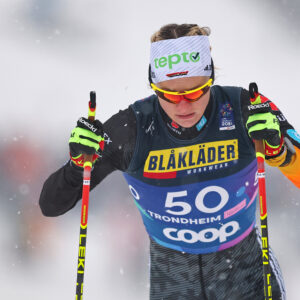
For Norwegian national team veteran Heidi Weng, simple is best. After over 15 years on the national team, her favorite workout is still 5×5 minutes.
Also Read – Heidi Weng: “I thought it was all over, then came the turning point”
“5×5 minutes with a 2-minute break is my favorite. I’m very fond of running, so it’s best for my legs. But it doesn’t matter the method or type of terrain. It can be run with or without poles, or on roller skis, for that matter.”
Why do you like that format?
“I don’t know. I just like the 5×5 minute format.”
How hard do you run these intervals?
“It depends on whether I do them alone or with others. With others, it’s always a bit tougher. I had a session like this on the roller ski track in Lillehammer with Lotta and Tiril (Udnes Weng) last year. There was a good atmosphere,” says Weng, looking over at Tiril, who nods approvingly and starts laughing.
“Yes, that 5×5 minute session with Heidi, Lotta, and me on the roller ski track in Lillehammer last year was something special,” confirms Tiril Udnes Weng to Langrenn.com.
Weng points out that by doing this session with others and on roller skis, she also gets to work on speed and capacity, which is a priority area for her this season.
“It will be more about speed than (when we do it together), and I’m not getting any faster over the years. Working well again in a sprint and having those qualities is important now. So, I will train a lot of speed to get the edge. I notice it, especially after I got the concussion, that I’ve lacked it a bit the last two years. So, I hope to get it back.”
The article continues below.

Speed pick-ups
Junior talent at Team Ragde Charge and reigning junior Norwegian sprint champion Oskar Opstad Vike surprised both competitors and commentators when he won the sprint battle for victory in Kanalrennet last summer. For him, speed pick-ups are his favorite.
“It’s boring to come into the race and not be fast enough to take the win,” says the junior sensation, who sprinted down Simen Hegstad Krüger and the entire world elite on the run-up after 50km.
This is the 20-year-old’s favorite session.
“I like variety, but I’m particularly fond of sessions with speed. One of my favorites is the speed pick-ups on roller skis, along with several others.
Why do you like it?
“I think it’s fun to get a bit of competition into the session, and that’s always the case when you do these speed runs with others.”
Specifically, what does a session like this look like?
“It’s a series of 10 to 12-speed runs in different types of terrain. Usually, it’s part of a longer session, often in the middle or towards the end. Sometimes, I run it as a separate session as well.”
How is the session structured (warm-up, main part, uphill)?
“I usually do anywhere from half an hour to an hour and a half before I do the pick-ups. I divide up it so that, for example, four are on a gentle uphill, four on a steeper uphill and four on a gentle downhill. The pick-ups last from 12 to 15 seconds, with maximum effort. I take a two- to three-minute break between each, and then I usually take it easy for 20 to 30 minutes at the end.”
What are the specific training benefits of this session/why is this helpful?
“Since you run the pick-ups in different types of terrain and together with others, you get to practice most things both technically and tactically, you get to practice competitive situations, and it helps to increase your top speed. This is crucial in today’s cross-country skiing with much more mass starts. After all, it’s boring to come into the race and not be fast enough to take the win. At the same time, the pick-ups are so short, and you have such good intervals that the session isn’t too hard either.”
How often do you run this session?
“I like to get one in at least once a week.”
How long does it take from start to shower?
“It depends on whether you do it after a half-hour warm-up or an hour and a half… But the part with the pick-ups usually takes around 45 minutes to an hour, including break intervals,” says Oskar Opstad Vike.
Also Read: Roller ski safety: Essential steps
The article continues below.

Sprint imitation
For Ansgar Evensen, the newest member of the Norwegian elite national team, sprint sessions are the favorite, albeit in a slightly bizarre way.
“I have a love/hate relationship with all sprint sessions in the summer. They’re tough, but they’re also the sessions where you push yourself to the limit. So, they’re both great and mentally tough at the same time.”
Evensen explains that such a session is run as a typical sprint in the winter.
“We usually do it after a normal sprint set-up. But we have shorter breaks in the summer, just five to ten minutes between heats. It makes it a bit extra tough,” he says.
“It’s harder than when you get 20 to 25 minutes between heats, like in winter competitions.”
What is the specific training effect of these sessions?
“These sessions have all the elements of exactly what we want to be good at in the winter. You get to train very specifically, both physically and tactically,” says Evensen.
How often do you run this type of session?
“Not very often. We hold back a little on these until late summer and early fall. But then there are usually three or four of them. It works well.”
Read More: Quit his job to focus on the national team

Are you interested in long-distance and traditional cross-country skiing training? Click HERE and read more about it.
Subscribe to our newsletter
Most read
-
-
26.09.2025
-
31.08.2025
-
15.07.2025
-
14.05.2025



More Articles
-
Team Futura GTE Trentino – Pro Team presentation Season XVII
Team Futura GTE Trentino is an Italian Pro Team with a long and proud history spanning more than four decades. Based in the iconic Val di Fiemme region, the team represents both tradition and progress, combining its deep local roots with an increasingly international outlook.16.01.2026